
Team Sport Speed is Not Track Speed
I often see team sport coaches and athletes pursue speed gains utilizing traditional track speed workouts and mechanics. After all, in track, the whole point is speed so why shouldn’t those workouts and mechanics apply? Why not utilize what the fastest athletes are using? I’m not here to argue which sport is “better” or who has faster or stronger athletes—I’m just here to clarify that team sport speed is a different style of speed than track speed, and we shouldn’t be viewing the two through the same lens.
Track speed is traditionally pretty, in a good way. The way elite sprinters float effortlessly down the track makes everyone stop and stare. It’s mesmerizing. While sport speed may not look as synchronistically fluid due to it’s chaotic nature, you can not deny the beauty of a well timed body-feint to get around an opponent. Team sports have different needs, goals, outcomes, and natural adaptations that develop from years of playing the sport. Training for team sport speed should have different points of emphasis from track speed. What I’ve seen over the years is not a lack of information, but a lack of understanding and application of the nuances that make team sport athletes fast, and how to truly nurture this style of speed.
This “Mechanisms for Speed” Mini Series is aimed at bringing about more clarity for team sport coaches and athletes alike, so we can decipher which areas of focus are going to align best with the goals of team sport athletes when they come to you and say, “I wanna get faster”.
Think about speed training like a jigsaw puzzle, a puzzle only becomes whole or “complete” when each individual piece connects seamlessly together. The lens that coaches traditionally view sprinting mechanics through makes us experts at pulling the puzzle apart and examining each piece, but not so good at linking it back together—which kinda defeats the purpose. Real world game mechanics of team sport make it a problem to overly focus on one sole attribute in a fixed training scenario (max force into the ground for example) only to realize that we can’t globally make that attribute fit back into the bigger whole when it’s actually time to sprint for sport.
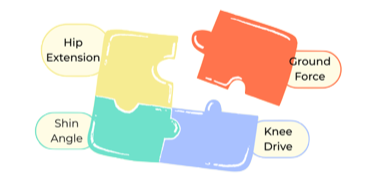
First, we need to have a clearer understanding of what is required in linking the puzzle again, and how to actually decipher what a team sport athlete truly needs when they say “faster”.
I work primarily with soccer athletes, so for this article I will use soccer as the default team sport example, but most of what I present here will transfer across many team sport scenarios. But before we get into the specific nuances of soccer speed, let’s examine some of the key differences between track and team sports.
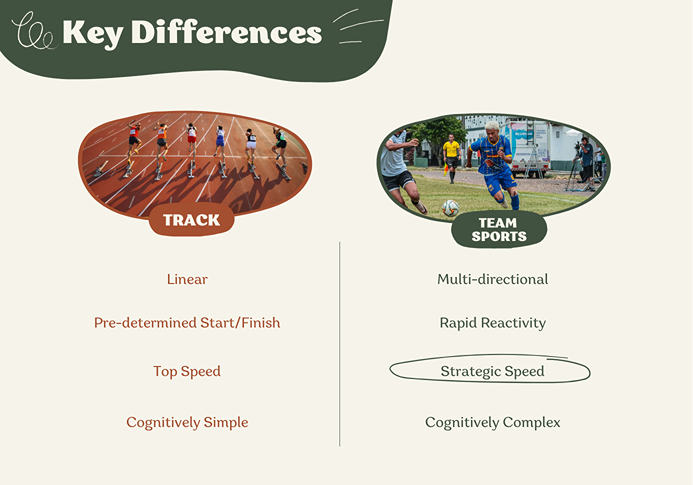
Track is a very linear sport in the sense that you are moving in one pre-determined direction. Human movement is never strictly “linear" in nature (as we’ll discuss in a future article in this series) but for now we’re keeping it basic. As we can observe in soccer, movement is very reactive, random, and multi-directional as dictated by the game; meaning that no two players will follow an exact pattern of movement.
While the overall goal of track is typically to get to the finish as fast as possible to win, soccer requires that athletes use their speed strategically, because the overall goal of the sport is to win by scoring the most goals—effective speed can impact that outcome, but it is not the sole variable.
Team sport is a multifaceted, complex event. Soccer athletes are individual parts of a bigger whole, meaning not only are they in charge of managing their own role, they are simultaneously communicating with their teammates, as well as tracking the opposing team’s moves.
Soccer speed is predominantly centered around opening or closing space on the field. Whether it’s (1) offensively creating opportunities to spread out and make runs/plays or (2) defensively closing gaps and breaking up the other team’s plays. To do that most efficiently and effectively athletes need to be:
Situationally and spatially aware;
Process scenarios quickly;
Move in and out of space rapidly and multi-directionally;
And manage recovery between bouts of sprints to sustain a high level of output over the course of the game.
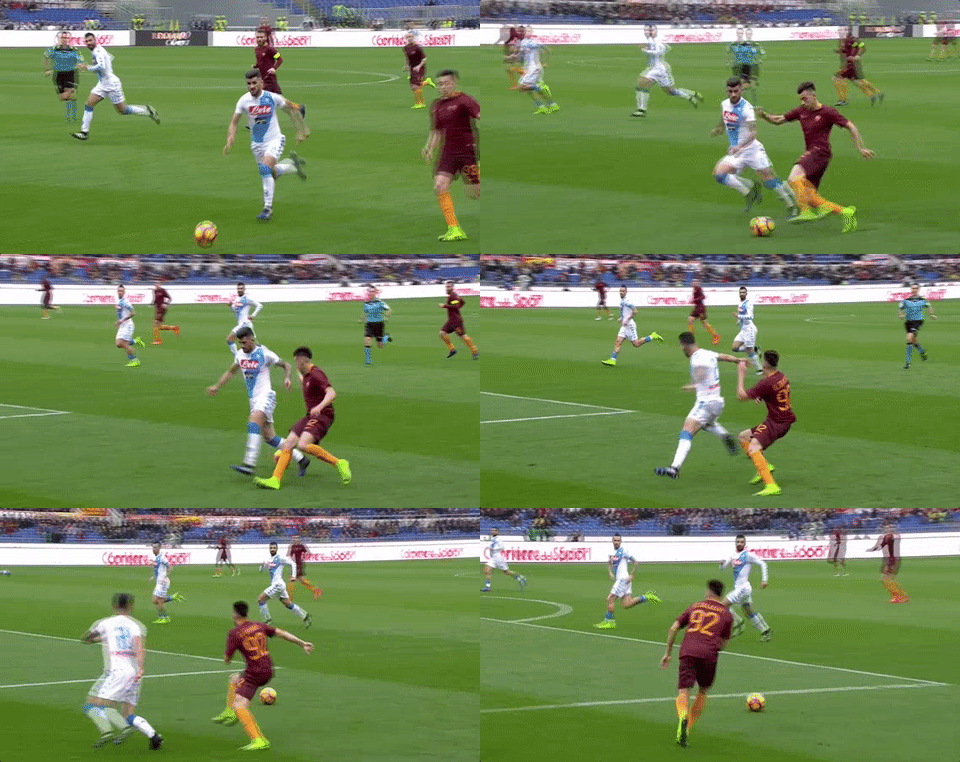
Because of this, solely relying on track-style drills like high knees, bounding for distance, or wall-runs will only take a team sport athlete’s speed development so far. Why? They’re limited in their strict linear nature and unbroken strides, their difference in energy system needs, and the controlled environment that you teach them in.
It’s not always the drills themselves, but the point of emphasis placed upon them when coached that doesn’t align with the attributes we want to express in sport speed. The traditional high knee drill (with an emphasis on driving the knees as high as possible) does not translate effectively because soccer is naturally played in a low center of mass “squatted” position. While traditional bounding emphasizes hip extension and pushing the ground away, I find it generally hard to teach to soccer athletes because it pulls them out of their natural cadence by keeping them in the air too long with prolonged switches. Soccer athletes are naturally rooted to the ground as the game is played at their feet, and I find large bounds don’t translate well to the rapid turnover speeds that in-game acceleration requires. Like bounds, wall runs also focus on putting force into the ground through hip and knee extension, but they emphasize the foot hitting too far behind the athlete’s center of mass, which is not how the stance leg functions when sprinting. During acceleration, the stance leg needs to hit under the athlete’s center of mass in order to function as a base of support for the rest of the body to travel over the top of.
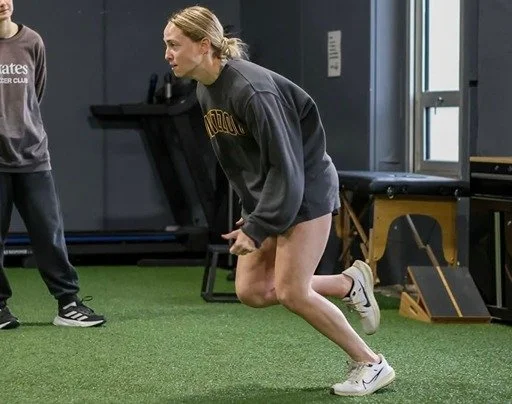
When we continue to splice the puzzle into smaller and smaller pieces it becomes hard to link it back together smoothly—with a misplaced focus on training individual speed expressions, instead of the overall foundation that allow us to truly express. Why do most coaches look for good hip extension in a sprint? Because it often results in the athlete covering more ground. That's not wrong. Good knee drive, hip extension, and forceful ground contact are important, but those attributes alone aren’t what makes athletes fast. It’s their ability to control all of those aspects with ease and at the right time, resulting in the fluidness you see on the field. Those attributes in themselves are actually a by-product of the entire system working congruently. If you ask your fastest soccer athlete on the team if they're thinking about their hip projection when they're sprinting in game, the answer is bound to be "no". Just as sprinting is not the actual task at hand, playing the game is (sprinting is a by-product). So the question becomes how can we better elicit the adaptions we want to see (like hip extension) in way that is going to translate better to actual on-field performance.
I don’t think all track drills are useless, in fact you can alter most of them to be appropriately utilized in a team sport setting (as we’ll discuss further in this series)—but team sport also requires variability and unpredictability, and your system for speed training should match that. Here’s how I typically assess initial needs.
The first thing I ask when an athlete wants ‘faster’ is, “Give me an in-game example of when you feel as though you’re not moving fast enough”. Almost always, the example given is on a transitional play. Transitional meaning: going from attacking to defending, or having to quickly change direction in response to the play unfolding. The second most common response is, “I am fast once I get going, but I have a hard time starting”.
Let’s expand on ‘Athlete A’ who feels slow on transitions. I typically hear this from my midfielders who play both sides of the ball, and my defenders. Usually they feel caught off guard in a quick counter-attack by the opposing team and they feel like they lag to get back behind the ball in transition. To evaluate these athletes I’m usually looking at things in a specific order.
First: What’s their body and spatial awareness like? Looking here at proprioception, vestibular, and visual systems. For example, your vestibular system tells your brain:
Where your head is in space;
How fast you are moving;
Whether you are rotating, tilting, accelerating, or decelerating;
Whether the ground beneath you is “trustworthy”.
Second: What’s their transitional speed like in a controlled setting?
For example: How fast can they get in and out of a cut with a pre-determined starting and stopping point?
Third: What’s their transitional speed like in a reactive setting?
How fast can they react to an audio or visual cue? Example: coach called cues for changing direction, reacting off of a partner/teammate, or scanning for a certain color cone.
Fourth: What’s their current ability to sustain a high output on repeated sprint bouts?
How quickly does their speed drop? Controlled example: a 10-5-10-15yd timed cut sprint with 1-2 minutes of walking or standing rest between bouts until the athlete can no longer sustain a window of ~3-5 seconds of their first time. How many “sets” do they get?
Once I understand the athlete’s weaker areas, we can start to build a program around those deficits.
Now let’s look at ‘Athlete B’ who feels slow in their initial acceleration. They feel like they’re running through quicksand in their first 1-3 steps. We will still utilize the same protocol above, just slightly different assessment drills based on what we want to see.
First: I will still always start with body and spatial awareness (more on this in a later article).
Second: What’s their acceleration speed in a controlled setting?
For example: How fast can they sprint 10-15yds with a pre-determined starting and stopping point?
Third: What’s their acceleration speed in a reactive setting?
How fast can they react to an audio or visual cue? Example: coach called cues for sprint starts, reacting off of a partner/teammate, or reacting to a thrown object like a tennis ball.
Fourth: What’s their current ability to sustain a high output on repeated sprint bouts?
How quickly does their speed drop? Controlled example: a 10 or 15yd timed sprint with a slow walk back to the starting line as their rest between bouts, until the athlete can no longer sustain a window of ~2 seconds of their first time. How many “sets” do they get?
Again, once we have feedback from those initial tests we can determine the course of best action to start. This does not mean that we only train transitional speed for Athlete A or only train starting speed for Athlete B. A well rounded program needs to encompass all that they are exposed to in-game, with additional emphasis placed on areas that need substantial improvement.
The last point for now is understanding that speed is a by-product of function and control of your entire system; you’re only ever as fast as your weakest link allows. Finding the weak link(s) allows us to elevate the entire system, allowing speed to become something that unfolds naturally, instead of something we solely “chase”.
We’ll dive into how to develop systems that link the ‘speed puzzle’ in the next article.
